


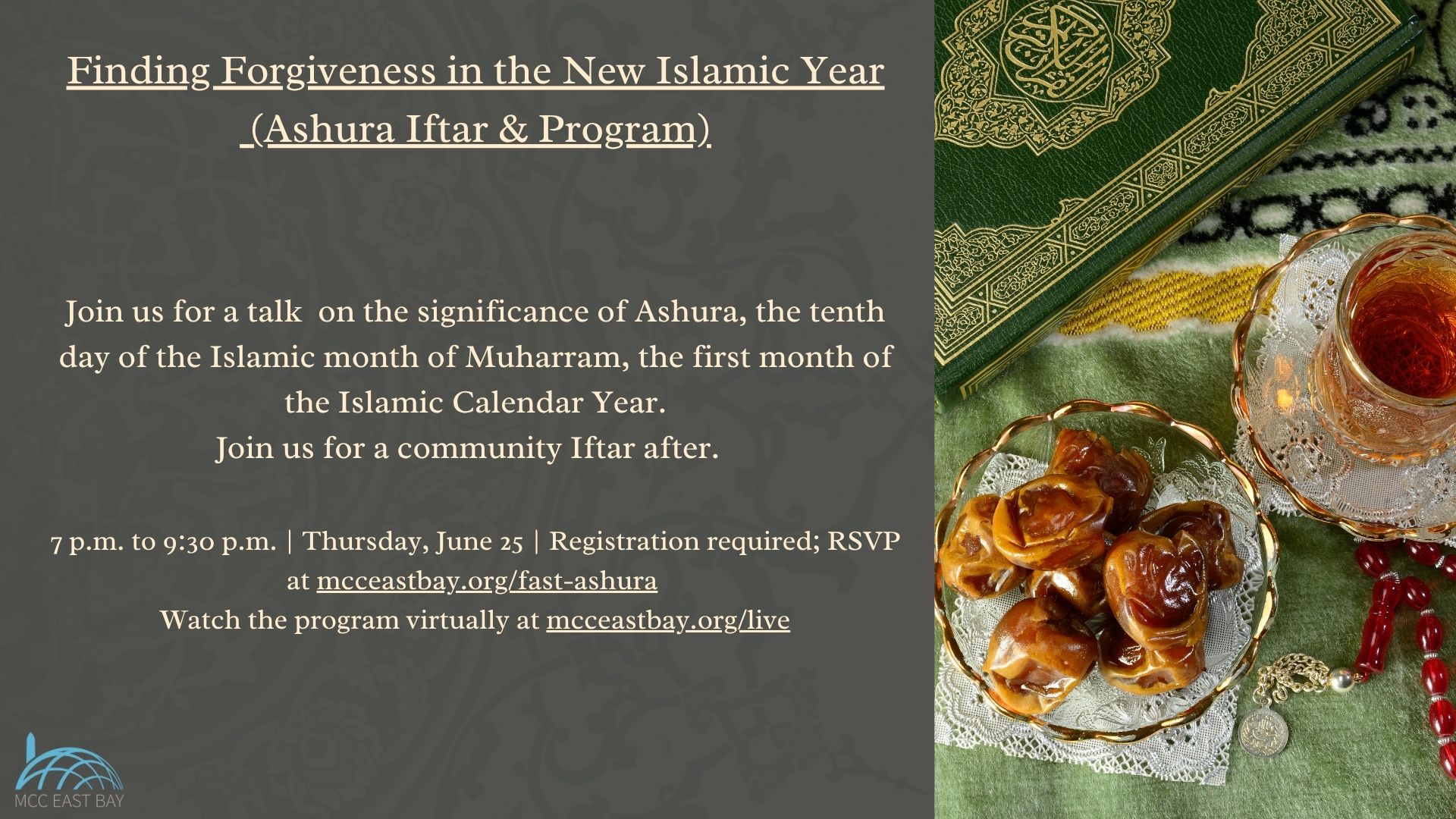
The Prophet Muhammad said, “Fasting the day of ‘Ashura, I hope from Allah, will expiate the sins of the previous year.”
(Sahih Muslim)
The blessed Day of ‘Ashura (Thursday, June 25, 2026) marks the tenth day of the Islamic month of Muharram, the first month of the Islamic Calendar Year. Join us for Iftar, followed by a free program featuring a guest speaker on finding forgiveness in the New Islamic Year.
Talk and Du’a with Ustadh Abdul Baseer: Mohammed Abdul Baseer is an engineer and a former president of Islamic Society of East Bay (ISEB) in Fremont. He has been active in the Bay Area Muslim community since the early 1990s. Br. Baseer and his family live in Fremont.
- More Imam Basir: https://mcceastbay.org/baseer
7 p.m. to 9:30 p.m. | Thursday, June 25 | $10/person for Iftar dinner; $2/person for kids (Pizza) | Registration required; RSVP at mcceastbay.org/fast-ashura | Watch the program virtually at mcceastbay.org/live
Muharram brings together two powerful stories: Allah’s rescue of Musa and the sacrifice of Imam Husayn. One is a story of deliverance. The other, a story of tragedy.
Both teach us profound lessons about faith, resilience, trust in God, and remaining steadfast through life’s greatest hardships.
The Prophet ﷺ called Muharram the “month of Allah.” As the new year begins, there’s no better time to reflect on the state of your heart through their stories.
Schedule of Events:
- Talk: 7 p.m. to 8:30 p.m.
- Maghrib prayer: 8:40 p.m. to 8:50 p.m.
- Iftar (dinner): 8:50 p.m. to 9:30 p.m.
- – More talks & sermons on Muharram: https://mcceastbay.org/muharram
- – For more information about the significance of the Day of Ashura, see https://seekersguidance.org/articles/the-day-of-ashura
- – Dua for the Day of Ashura: https://drive.google.com/file/d/1eDyBp2nvN1W9nqnjrmpmsl2-UWuSRu-b/view?usp=drive_link
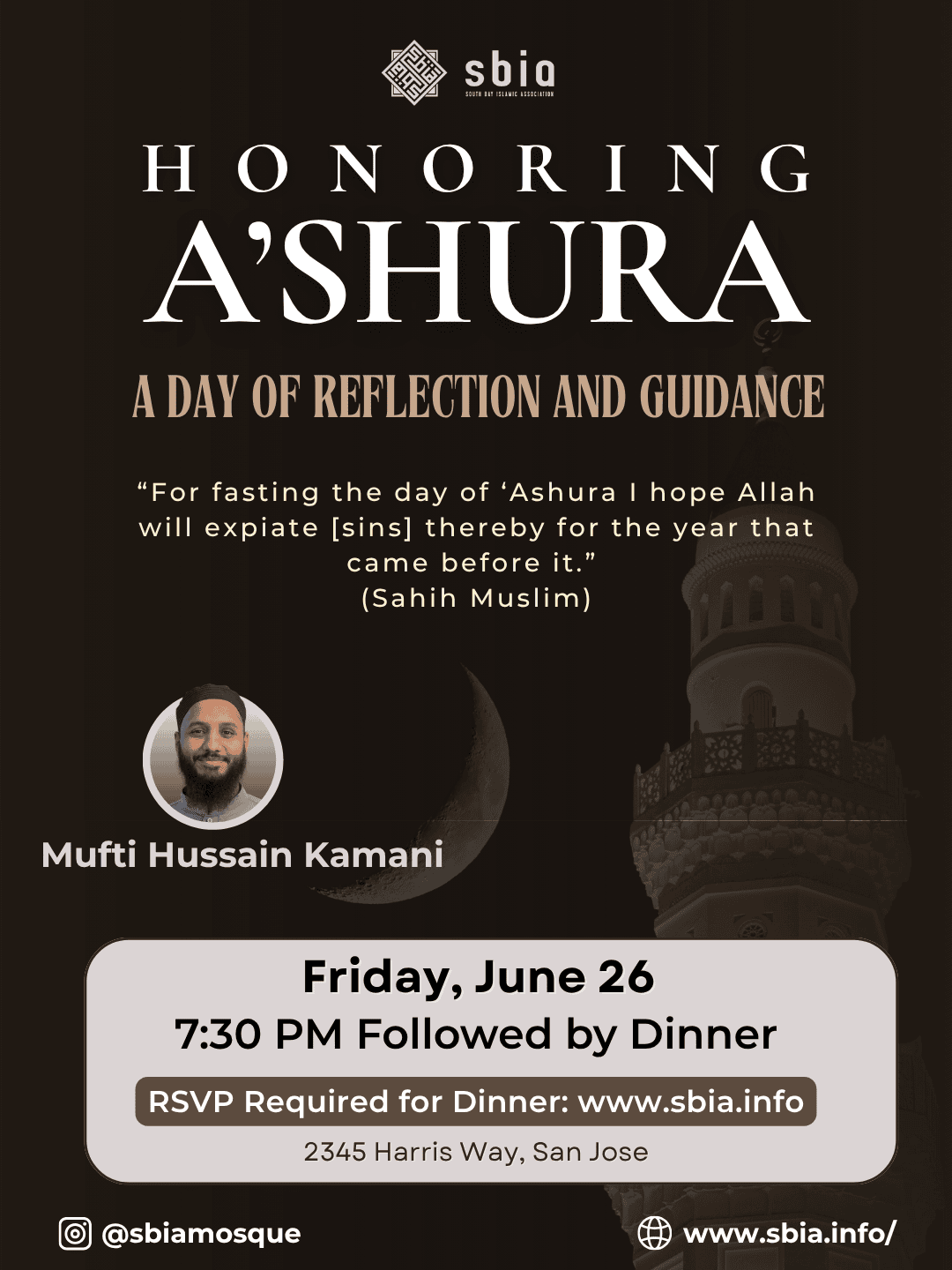
Our friends at SBIA also have an Iftar and program on Friday, June 26, 2026: https://docs.google.com/forms/d/e/1FAIpQLSfznKSWs140BB3vFfmcajb-2K1mtx6RmxeuUNMdv7J5Cq525A/viewform?mc_cid=898db9d7d2&mc_eid=2a56a113cc
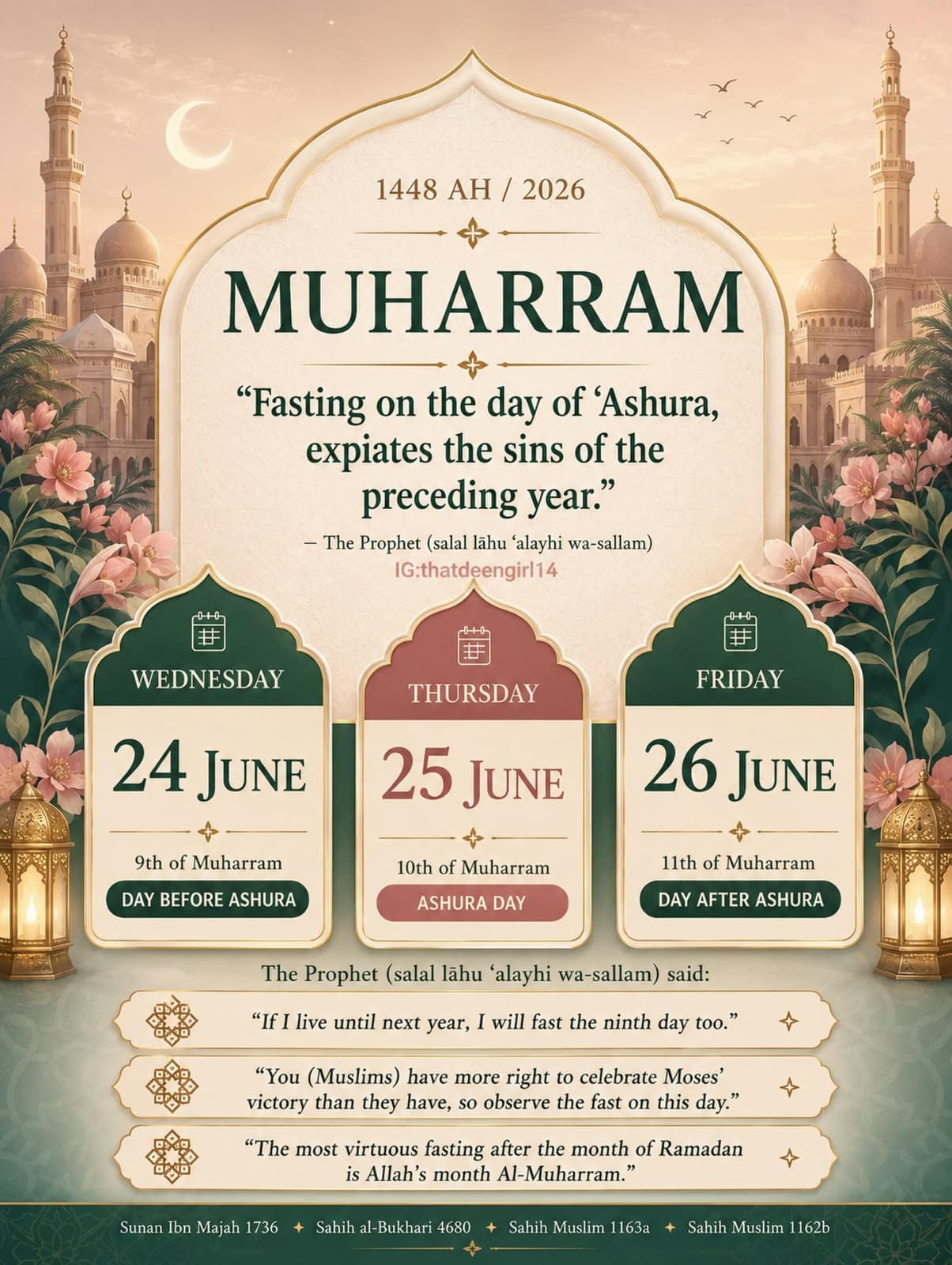
Thursday, June 25, 2026, marks the tenth day of the Islamic month of Muharram, the first month of the Islamic Calendar Year. It is considered special by all Muslims and is one of the four sacred months. During this month is the Day of Ashura, or the “Tenth day” of the month, which will be Saturday, July 5th. Fasting is recommended (with or without adding a day before or after). Imam Muslim reported that the Prophet PBUH said, “The best of fasts after the month of Ramadan are in the Month of Allah, which you call Muharram. And the best of prayer after the obligatory prayer is the night prayer.”
While Ashura is primarily associated with the story of Moses (peace be upon him), it is also the day on which another profound event occurred—the martyrdom of Hussein, the beloved grandson of the Prophet (peace be upon him). May God be pleased with him.
Questions? events@mcceastbay.org
What is the Day of Ashura?
Ashura marks the day when God parted the Red Sea to save Moses and the Israelites from Pharaoh, and is the Islamic equivalent of Yom Kippur. In Sunni Islam, Ashura follows Jewish traditions, with a day of fasting that commemorates the parting of the Red Sea for Moses and his followers as they escaped from Pharaoh. The Prophet Muhammad thought this tradition was worth following, so he fasted and encouraged his followers to do the same. On this day, Muslims fast and celebrate by reflecting, showing respect, and giving thanks. Is fasting required? Fasting is not compulsory during Ashura, but some Muslims choose to fast for one or two days. This is because the Prophet Muhammad was said to have fasted on the day of Ashura.
When is Ashura 2026?
Ashura falls on the tenth day of Muharram (the first month of the Islamic year) in the Muslim calendar, and this year it is on Friday, June 26, 2025. Islamic religious dates are tabular: they begin at sunset on the first evening and end at sunset on the second evening. The date changes each year because the Hijri calendar, used by Muslims, is 10 to 12 days shorter than the Gregorian calendar.
MCC follows the traditional moon-sighting method, which relies on regional, verifiable naked-eye sightings of the new crescent moon to determine the start of all Hijri months. Please see this video to understand this practice. MCC honors the variation in the beginning of each Islamic month, as the new moon is sighted on different days in different places, and some communities perform moon calculations. All are valid. Please observe with your community.
Questions? events@mcceastbay.org
- – More talks & sermons on Muharram: https://mcceastbay.org/muharram
The month of Muharram is considered special by all Muslims and is one of the four sacred months of the year, which brings with it the day of Ashura, or the “Tenth day” of the month, when fasting is recommended (with or without the addition of a day prior or after). Following the Prophetic tradition, MCC invites all East Bay residents to observe a day of fasting on the Day of Ashura.
The first is the Hijrah, the migration of Prophet Muhammad (peace be upon him) and his companions from Mecca to Medina in 622 AD. The birth of a pluralistic Muslim community marks the beginning of the Islamic calendar and served as the key turning point for the first Muslims and the future of Islam.
The Hijrah also marks the start of a new chapter for humanity, where freedom of faith and justice for all became the cardinal principles of the newly founded society and a model for us to aspire to.
The other two historical events took place on the 10th day of Muharram, known as Ashura. After completing the migration to Medina, the Prophet witnessed the Jews of Medina fasting to commemorate the victory of Prophet Musa (PBUH) and his people over the Egyptian Pharaoh. Prophet Muhammad then asked his companions to join this fasting tradition to express their gratitude to Allah for saving Musa and his people. On the same day, just six decades later, the Prophet’s grandson Husayn ibn Ali was martyred in the Battle of Karbala. This was one of the saddest and most heartbreaking events in the history of Islam, which we continue to mourn today.
As we commemorate Ashura for Prophet Musa and Imam Husayn, we are called to re-commit to our struggle against all forms of tyranny and oppression and to seek liberty and justice for all. Following the Prophet Muhammad’s tradition, MCC invites you all to observe the fast of Ashura.
Let us take this day to continue the practice of our beloved Prophet and pray for the unity of our ummah (community).
- Seekers Guidance article: https://
seekersguidance.org/articles/ the-day-of-ashura/ - For a quick read, here are some infographics from SeekersGuidance:
https://www.facebook.com/47051192317/posts/ pfbid0S8QCwXfGGV6TcKLKQHEjNnRm DjLnWZqAd7XjQ1GNSqVSayyNMRJnid qTreYSzytpl/
Today is the first day of Muharram, one of the four sacred months in the Islamic calendar, as mentioned in the Quran, marking the start of a new Islamic calendar year, 1447. This day marks the beginning of the Hijrah (migration), when the Prophet (PBUH) traveled from Makkah to Madinah in 622 AD.
As we enter this blessed month, with so much uncertainty and hardship around the world, we are reminded that the Hijrah was more than a journey; it was a turning point for our Ummah. It is an invitation for all of us to reflect, renew our intentions, and recommit to living lives rooted in faith, purpose, and justice.
We ask Allah (SWT) to bring great good to the Ummah in this new year, rectify its affairs, and bring relief to those who are suffering. Peace and blessings be upon the one whose Hijrah marks the beginning of our calendar, our Prophet Muhammad, and his blessed family and Companions, and all those who follow him until the last day.
-
- Historical Origins: The fast commemorates the day Allah saved Prophet Moses (Musa) and the Children of Israel from Pharaoh by splitting the sea. Prophet Muhammad observed this fast and encouraged Muslims to do the same in gratitude. [1, 2, 3]
- The Recommended Method: To distinguish the Islamic fast from the practices of other faiths, it is highly recommended to fast on the 9th and 10th of Muharram, or the 10th and 11th. Fasting the 10th day alone is generally permissible, but adding an adjacent day is preferred. [1, 2]
- Rewards: Prophet Muhammad stated that fasting Ashura is the most virtuous voluntary fast after Ramadan, wiping out the minor sins of the past year. [1]
- Shia Perspective: In Shia tradition, while the day is universally deeply sorrowful as it marks the martyrdom of Imam Hussein (the Prophet’s grandson) at Karbala, the act of fasting on Ashura is not practiced in the same celebratory or prophetic context and is instead viewed as a day of mourning and abstaining from food out of grief. [1, 2, 3]
The Prophet ﷺ never abandoned fasting on the day of Ashura. We are told that, “There are four things which the Prophet never gave up: fasting Ashura, fasting during the ten days [of Dhul Hijjah], fasting three days of each month, and praying two rak’at before al-ghadah [i.e., Fajr].” [Sunan Al-Nasa’i #2416].
Given that fasting on Ashura was so important to the Prophet ﷺ, you might be curious why this day is significant. Many of you may have heard that the Prophet ﷺ began fasting on the day of Ashura when he arrived in Madinah and found the Jews fasting on that day because it coincided with Passover. Ibn Abbas (rA) narrated that:
“When the Prophet ﷺ arrived at Madinah, the Jews were observing the fast on Ashura, and they said, ‘This is the day when Moses became victorious over Pharaoh.’ On that, the Prophet ﷺ said to his companions, ‘You (Muslims) have more right to celebrate Moses’ victory than they have, so observe the fast on this day.’” [Sahih Al-Bukhari #4680]