


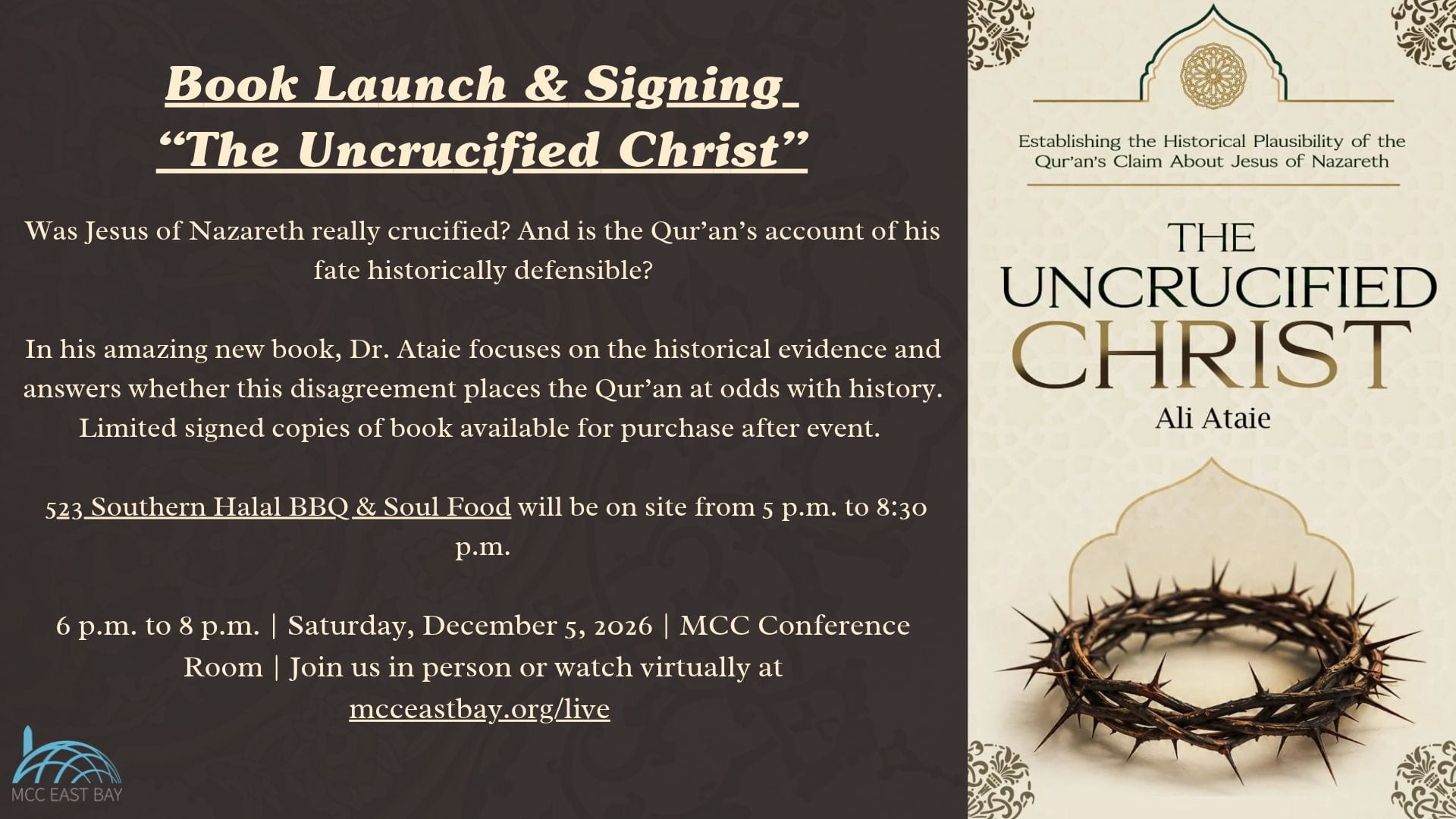
Was Jesus of Nazareth really crucified? And is the Qur’an’s account of his fate historically defensible?
“The Uncrucified Christ”: Establishing the Historical Plausibility of the Qur’an’s Claim About Jesus of Nazareth
The Qur’an declares that Jesus of Nazareth (AS) was neither killed nor crucified. This is a strikingly different account of a central Christian belief nearly 2,000 years old.
In his new book, Dr. Ataie focuses on the historical evidence and asks whether this disagreement puts the Qur’an at odds with history. Limited signed copies of the book available for purchase after the event.
6 p.m. to 8 p.m. | Saturday, December 5, 2026 | MCC Conference Room | Join us in person or watch virtually at mcceastbay.org/live
Questions? events@mcceastbay.org
Hungry? Have dinner at MCC with your family before, during, or after the lecture. 523 Southern Halal BBQ & Soul Food will be on site from 5 p.m. to 8:30 p.m. To pre-order, please use the QR code below. Please note what time you want your food to be ready.

Featuring an Introduction by Dr. Khalid Yahya Blankinship and a Publisher’s Preface by Dr. Abdullah bin Hamid Ali
Was Jesus of Nazareth really crucified? And is the Qur’an’s account of his fate historically defensible?
For nearly two thousand years, the crucifixion of Jesus has occupied a central place in Christian belief. Today, it is also widely regarded as one of the most firmly established events in the life of the historical Jesus. Yet the Qur’an presents a strikingly different account, declaring that Jesus was neither killed nor crucified.
Does this disagreement place the Qur’an at odds with history – or does the historical evidence deserve a closer examination?
In The Uncrucified Christ: Establishing the Historical Plausibility of the Qur’an’s Claim About Jesus of Nazareth, Dr. Ali Ataie undertakes a rigorous investigation of one of the most consequential questions in Christian-Muslim dialogue.
Drawing on biblical scholarship, early Christian history, Qur’anic interpretation, and modern historiographical methods, Dr. Ataie critically examines the sources and assumptions underlying the traditional crucifixion narrative.
Distinguished Scholarly Contributions
This important publication includes an Introduction by Dr. Khalid Yahya Blankinship, a distinguished historian and scholar of Islamic history, and a Publisher’s Preface by Dr. Abdullah bin Hamid Ali, an Islamic scholar, professor at Zaytuna College, and founding director of the Lamppost Education Initiative.
Their contributions provide additional scholarly context for Dr. Ataie’s examination of the historical evidence surrounding the crucifixion of Jesus of Nazareth.
Among the subjects explored are:
-
The historical reliability of the Gospel accounts of Jesus’ passion.
-
The testimony of early Christian, Jewish, and Roman sources.
-
The influence of Paul on early Christian understandings of Jesus’ death.
-
The Synoptic Problem and the development of early Christian traditions.
-
Classical Muslim explanations of Qur’an 4:157, including substitution, divine rescue, and the swoon theory.
-
Alternative historical reconstructions consistent with the Qur’anic account.
Rather than claiming absolute historical certainty, Dr. Ataie advances a carefully defended argument: that the non-crucifixion of Jesus is a historically plausible position worthy of serious scholarly consideration.
By distinguishing historical possibility from historical plausibility, he invites readers to reconsider the evidence, question inherited assumptions, and examine whether the Qur’an’s account can be reconciled with responsible historical inquiry.
The Uncrucified Christ is a thought-provoking contribution to Islamic studies, biblical scholarship, the historical study of Jesus, and Christian-Muslim dialogue.
For readers interested in the historical Jesus, the origins of Christianity, Qur’anic studies, and the relationship between faith and historical evidence, this book offers a challenging and illuminating perspective on a question that has shaped religious thought for centuries.
Published by Lamppost Education Initiative.
About the Author
Dr. Ali Ataie is a scholar of biblical hermeneutics with field specialties in Sacred Languages, Comparative Theology, and Comparative Literature. At Zaytuna College, Dr. Ataie has taught Arabic, Creedal Theology, Comparative Theology, Sciences of the Qur’an, Introduction to the Qur’an, and Seminal Ancient Texts. He received his BS in accounting from Cal Poly State University in 2000. In 2011, he received his MA in Biblical Studies from Pacific School of Religion, and in 2016, his PhD in Cultural and Historical Studies in Religion from the Graduate Theological Union. Dr. Ataie’s PhD thesis, titled “Authenticating the Johannine Injil: Muslim ‘Polemirenic’ Interpretive Approaches to the Gospel of John,” is a faith-based hermeneutic of the Gospel of John that authenticates the entire text as the true Gospel of Jesus Christ mentioned in the Qur’an. Dr. Ataie is a native Persian speaker. He can read and write Arabic, Hebrew, and Greek. Dr. Ataie joined the Zaytuna College faculty in 2012.