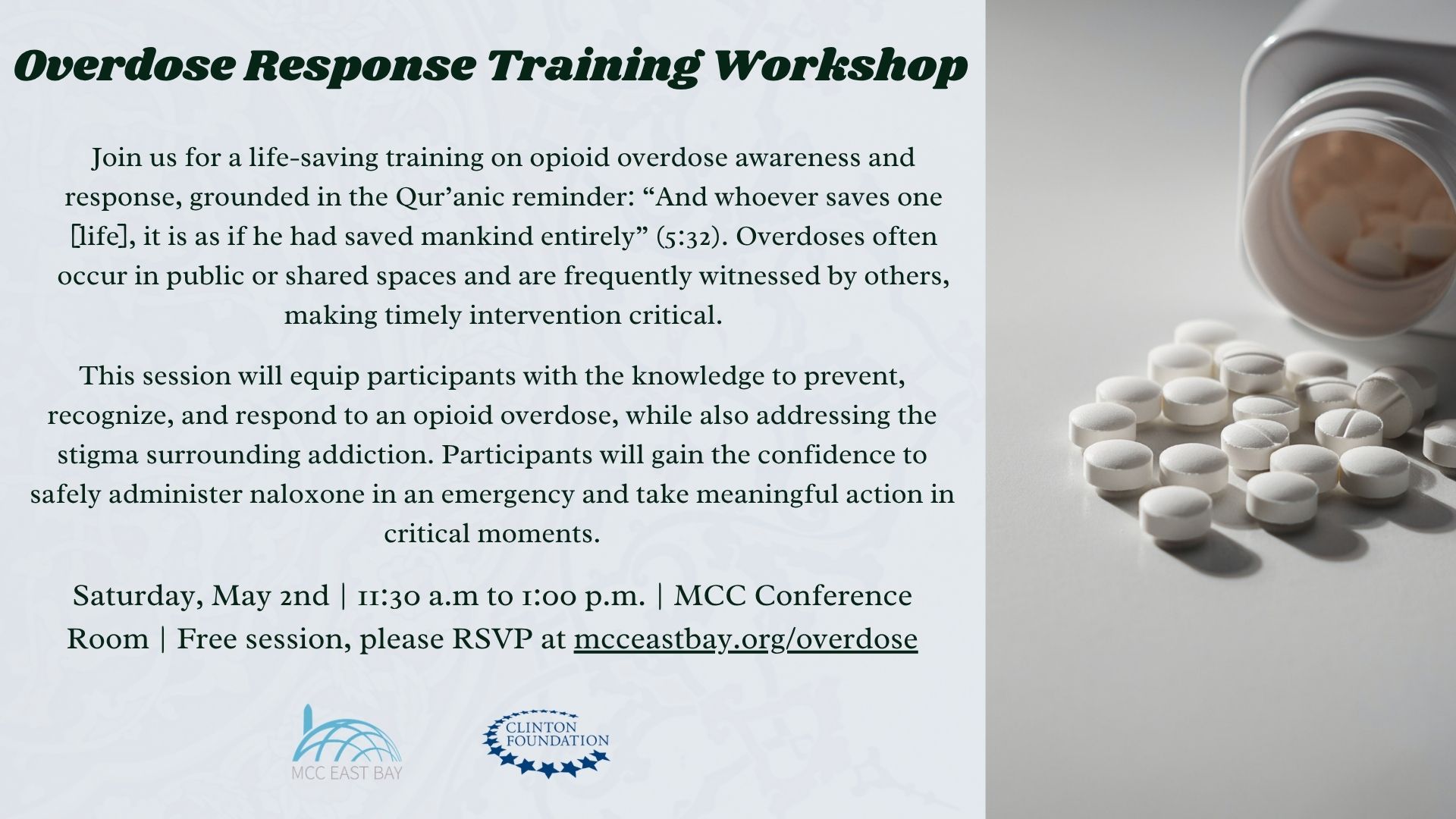
Join us for a life-saving training on opioid overdose awareness and response, grounded in the Qur’anic reminder: “And whoever saves one [life], it is as if he had saved mankind entirely” (5:32). Overdoses often occur in public or shared spaces and are frequently witnessed by others, making timely intervention critical.
This session will equip participants with the knowledge to prevent, recognize, and respond to an opioid overdose, while also addressing the stigma surrounding addiction. Participants will gain the confidence to safely administer naloxone in an emergency and take meaningful action in critical moments.
Saturday, May 2, 2026 | 11:30 a.m to 1:00 p.m. | MCC Conference Room | Free session; please RSVP at mcceastbay.org/overdose
Sponsored by The Clinton Foundation & MCC East Bay.
Questions? events@mcceastbay.org
About the Facilitator, Yumna Battisha
Yumna Battisha is a UCLA graduate with a degree in Psychology, currently working in overdose prevention and harm reduction. She serves as the Director of Public Relations at T.A.C.O. Inc. (Team Awareness Combatting Overdose), where she focuses on community outreach, education, and expanding access to life-saving resources such as naloxone and fentanyl test strips. She is also a fellow with The Clinton Foundation, where she explores faith-based approaches to addressing substance use and the overdose crisis. Her work is centered on making harm reduction more accessible, culturally relevant, and stigma-free, with a strong commitment to equipping communities with the knowledge and tools to save lives.
Why This Is Important
The U.S. overdose crisis is among the most pressing and indiscriminate health challenges of our time. More than 100,000 Americans died from drug overdose during the 12-month period ending in April 2021, up almost 30 percent from the same period a year earlier. One life lost due to overdose is one too many, and more must be done to save lives.
Faith leaders are a trusted source of support and information, and can influence attitudes and practices at the individual, household, and community levels. Faith leaders can use their unique and powerful platform to shatter the stigma that all too often keeps addiction in the shadows and blocks access to supportive resources. When faith leaders know how to respond, they become a vital part of the solution to ending addiction and the overdose crisis.
WHAT IS THE EMPOWERING FAITH LEADERS PROGRAM?
The Clinton Foundation collaborates with state and local partners, including Georgia’s Department of Behavioral Health and Developmental Disabilities, Savannah’s Interfaith Addiction and Recovery Coalition, and the Georgia Council on Substance Abuse, to train faith leaders to address addiction and the overdose crisis using evidence-informed, compassionate approaches. The program is free of cost.
Faith leaders who participate:
- Build knowledge, skills, and confidence to address addiction and the overdose crisis.
- Learn about local prevention, treatment, and recovery, and harm reduction resources.
- Receive $2,000.00 in funding and technical support to plan and implement community-based engagement projects to raise awareness, share resources, and reduce stigma.
- Explore how different faith traditions view substance use, addiction, and recovery, and build bridges across communities.
- Join a state-wide and national network of faith leaders working to address the issues.
CURRICULUM OVERVIEW
- MODULE 1: Overview of the Overdose Epidemic and Community-Based Needs Assessment
- MODULE 2: Introduction to Community-Based Engagement Projects and Program Evaluation
- MODULE 3: Science of Addiction and The Role of Faith Leaders
- MODULE 4: Interfaith Dialogue and Collaboration
- MODULE 5: Overdose Prevention and Naloxone Training
- MODULE 6: Addressing Stigma from the Pulpit and Beyond
- MODULE 7: Community-Based Engagement Project Planning
- MODULE 8: Evidence-Based Treatment for Substance Use Disorders
- MODULE 9: Recovery from Substance Use Disorders
- MODULE 10: Community-Based Engagement Project Outcomes and Sustainability Plans